Everything You Need to Know About Speed Signs with Radar
A radar speed feedback sign measures an approaching vehicle’s speed and displays feedback to the driver. For a purchasing decision, the useful questions are where it will be installed, what it must display and which functions are actually included.
Detect approaching vehicles
Position and alignment affect the measurement. Confirm the detection direction and site geometry.
Give the driver feedback
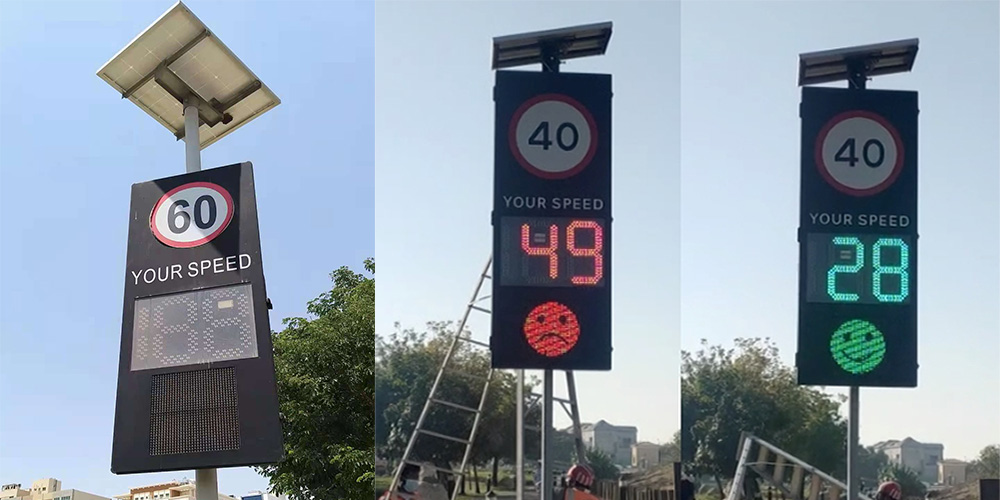
The example value shown is illustrative. Colours and display modes depend on the model and local requirements.
Choose the options separately
Power supply, data logging and remote connectivity must each be confirmed in the proposal.
Detection and display
The radar estimates speed and the display presents the result. Detection direction, vehicle paths, sensor alignment and site conditions affect the measurement. Ask for the declared accuracy and its test conditions rather than assuming identical results at every site.
Digits, messages, colours and symbols depend on the selected model and configuration. Their suitability also depends on the road authority’s requirements; a display option shown in a catalogue is not automatically permitted in every country.
Feedback is different from enforcement
Displaying a measured speed does not itself establish a legal speed limit or make the sign a ticketing device. Keep the proposed feedback display consistent with the authorised traffic signing for the location.
For US projects, consult the applicable MUTCD provisions. They are not a universal specification for other markets. Confirm the display rules for the actual destination.
Power, data and optional equipment
Confirm mains, battery or solar supply and the intended operating schedule. Solar sizing requires the load, site exposure and required reserve to be assessed together.
Data logging, remote communication and cameras are separate configuration questions. Ask what is supplied, what data can be exported and what the local requirements are for its use.
Prepare a useful enquiry
Provide the site type, approach speed, reading distance, lane arrangement, installation position and available power. Explain whether the goal is immediate driver feedback, traffic data collection or both.
Ask for the model documentation, mounting requirements, included software and maintenance needs. Avoid comparing products on screen appearance alone.
Information to send with your enquiry
| Topic | Details to confirm |
|---|---|
| Road layout | Approach direction, lane arrangement and reading distance |
| Display | Required units, messages and local display rules |
| Power | Available supply and operating schedule |
| Options | Data logging, communication, cameras and software |