
How Big Are Traffic Lights? Size, Installation, and More
A traffic light’s advertised size usually describes its optical diameter, not the complete housing or the required mounting clearance. A useful purchasing drawing must show all three.
Optical diameter and enclosure size
Commercial 8-inch and 12-inch categories are commonly associated with nominal 200 mm and 300 mm optics. These are category labels, not exact inch-to-millimetre conversions or universal rules about where a signal may be installed.
Choose the model using the required signal type, visibility, approach conditions and local specifications. A larger intersection or a residential location alone does not determine the correct diameter.
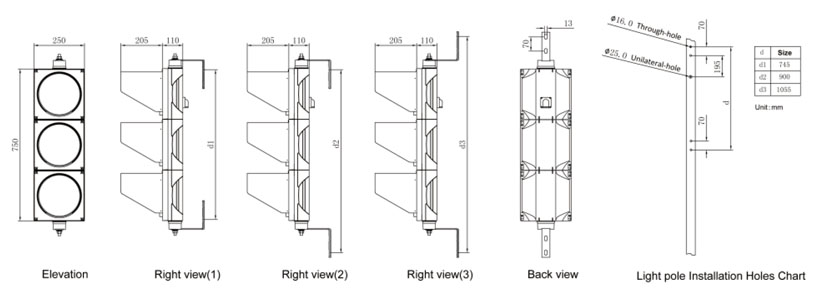
Mounting height and available space
Mounting height, lateral position and clearance depend on the support, carriageway and applicable design rules. There is no single height range suitable for every country or installation.
Ask for housing dimensions, bracket geometry, mounting points and adjustment space. Check the complete assembly, including visors and any backplate, against the site design.
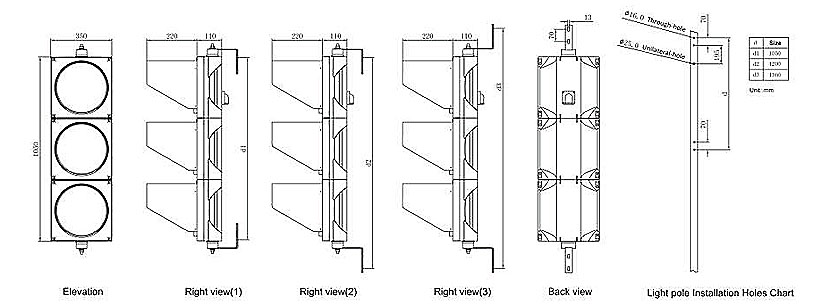
Understand the main components
The housing supports and protects the modules; the light modules display the indications. Visors help manage glare, and a backplate can improve contrast against the background. Brackets support the unit and allow the specified alignment.
The controller manages phases and timing. Detectors and central supervision depend on the project configuration; they are not compulsory components of every signal installation.
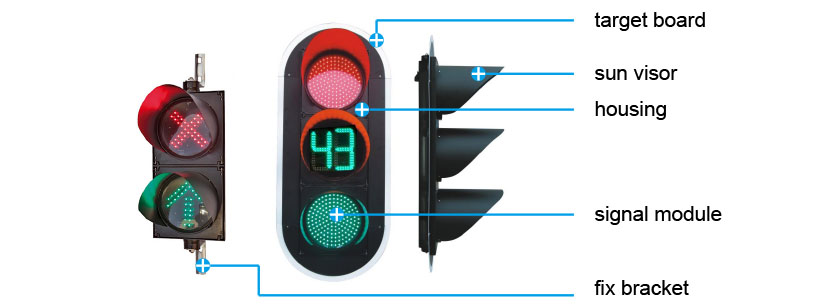
Prepare a model-specific request
Provide the indication type, optical size if specified, supply voltage, mounting arrangement and environmental conditions. Request the dimensioned drawing and documentation for the exact version offered. The figures below are existing examples, not drawings for every model.